
As predicted, fares are going up on Metro-North rides in Connecticut by 5% starting Sept. 1 with another 5% hike coming next July.
Rising Price
The final approval came days ago from the MTA, parent of Metro-North, which rubber-stamped the fare hike decision by the Connecticut Department of Transportation.
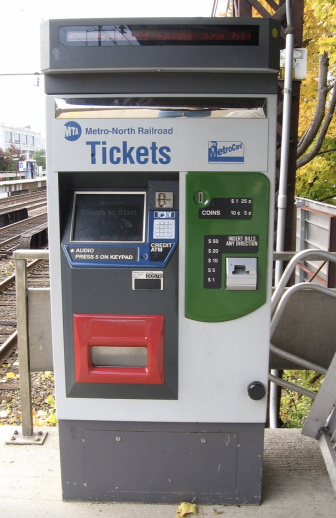
Photo by User:Noroton on Wikimedia Commons
This Metro-North machine will be dispensing more expensive tickets.
At least one MTA board member called the hikes “scary” and another exclaimed that he was “actually kind of offended.” But, hey — there is nobody on the MTA Board representing Connecticut riders, so they both voted to approve the hike, as did the entire MTA Board. After all, it’s not their money.
Mind you, the MTA is also shortly expected to approve a 4.4% fare hike for New York’s Metro-North riders as well as a 25-cent increase for NYC subways and buses, so put that in your pipe of moral indignation and smoke it.
As I explained a few weeks ago, the Connecticut fare increase can be blamed on the governor and Legislature, which knowingly undercut the CDOT budget, pretty much telling the agency to raise fares to make up the difference. After all, they seem to assume that everyone who rides Metro-North along Connecticut’s “Gold Coast” is a millionaire.
But a 10% increase in one year? On top of a 4.5% hike just two years ago? That adds up to a compounded 15.2% increase since 2023 — way more than inflation. Remember, Metro-North has a captive audience and can do anything it wants.
More Inconvenience
And adding insult to injury, there are new ticket rules coming! With more and more commuters buying one-way e-tickets (57%) instead of monthly passes (36%), those tickets will automatically be activated on purchase, not when you get on the train and activate them yourself. Why? Because, the railroad says, 55% of ticket holders don’t activate their tickets until they see the conductor coming around.
But isn’t it the conductor’s job to collect those fares and put seat checks on each row?
According to MTA Deputy Chief Jessica Lazarus, “Conductors are spending more than 20,000 hours each year reminding customers to activate one-way mobile tickets.” Really? How did they come up with that metric?

Photo from the MTA
A Metro-North conductor
Requiring activation of the ticket at time of purchase, she says, will “recapture those hours that can be better put to use for fare collection and train safety operations.” Like enforcing the “no radios rule” and “no feet on seats”?
If you’re doing a same-day round trip you won’t buy two one-way tickets but, instead, a new Day Pass. Good for unlimited travel until 4 a.m. the next day, day-trippers using the pass will get a 10% fare discount compared to buying two one-way peak tickets.
For hybrid commuters, after buying 10 one-way tickets within two weeks the eleventh will be free. For seniors, the disabled and those on Medicare the new reduced fare ticket will be valid at all times, even in the morning peak.
Make no mistake: Fare evasion is a serious problem for MTA, which estimates they lose $700 million each year, most of it on buses ($315,000) and subways ($285,ooo). Metro-North losses are estimated at $44,ooo.
Given that train fares are much more expensive than bus and subway, that’s not a lot of commuter scofflaws; just 6% of riders compared to 15% of subways riders and 37% of bus passengers.
Of course, bus riders can easily board by the rear door and subway riders can jump over turnstiles. On Metro-North we have conductors. It’s an hour-long ride from Stamford to Grand Central, plenty of time to look at everyone’s ticket — which conductors will still have to do even under the new rules.
But what about the Dashing Dan running to make his train, grabbing a seat and then trying to buy an e-ticket in a cellphone dead spot, nervously watching the conductor moving down the aisle? No ticket to show? You’ll get whacked with a $2 surcharge.
Here are the optics: Connecticut lawmakers short-change the CDOT budget, basically saying, “Let the commuters pick up the tab.” Now MTA makes commuting less convenient with new ticket rules.
We all end up paying more and getting no improvement. The trains are no faster or reliable. And maybe less attractive as a transportation choice.
____________________

Contributed photo
Jim Cameron
Jim Cameron has been a Darien resident for more than 30 years. He is the founder of the Commuter Action Group and also serves on the Darien RTM and as program director for Darien TV79. You can reach him at CommuterActionGroup@gmail.com.